Those who love mountains and wild nature should definitely visit the surroundings of Mount Kazbek, the second-highest five-thousander in the Caucasus after Mount Elbrus. Adventurous travelers and mountaineering enthusiasts can even attempt to conquer this majestic peak, which attracts visitors with its powerful and mysterious beauty.
- Kazbegi in facts
- Legends and name
- Attractions around
- Climbing Kazbegi
- Alexander Kazbegi
- Infrastructure
- Climate
- How to get
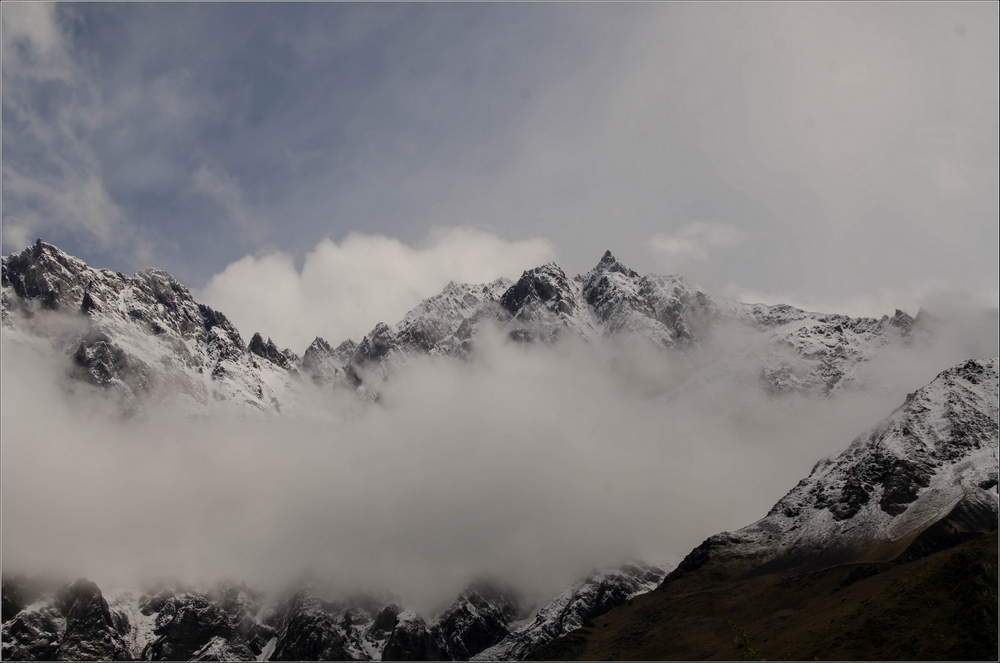
Kazbegi in facts
Mount Kazbek is an extinct stratovolcano rising to 5,033 metres. It stands on the border between Russia and Georgia. The volcano last erupted around 650 BC. Although Kazbek is slightly lower than Mount Elbrus — the highest peak in Russia and Europe at 5,642 metres — it remains one of the most iconic mountains of the Caucasus.
The volcanic origin of Kazbek is visible throughout the surrounding landscape. In the nearby Dariali Gorge, visitors can see dark black and grey lava deposits with pink speckles — remnants of ancient lava flows that once poured down the slopes of the volcano.
Glaciers of Kazbegi
At elevations above 3,300 metres, Mount Kazbegi is covered with permanent glaciers. Among the largest are:
- Chach Glacier — located to the north
- Devdoraksky Glacier — in the north-east
- Maily Glacier — the widest glacier, in the north-west
- Gergetsky Glacier — in the south-east
- Abano Glacier — in the east
These glaciers shape the dramatic alpine landscape that surrounds the mountain.
Two Peaks of Kazbegi
Mount Kazbegi consists of two main summits connected by a ridge:
- Eastern Kazbegi — 5,033 metres (the highest point)
- Western Kazbegi — 5,025 metres
The ridge connecting the two peaks reaches a height of 5,005 metres.
First Ascents
The first recorded ascent of Mount Kazbegi took place in 1868, when three English climbers — Douglas Freshfield, Adolphus Warburton Moore, and Charles Comyns Tucker — successfully reached the summit.
Later, in 1889, Russian topographer Andrei Pastukhov carried out one of the first scientific explorations of the mountain and also climbed to its summit.
Today, Mount Kazbek remains one of the most popular mountaineering and trekking destinations in the Caucasus, attracting hikers, climbers, and photographers from around the world.
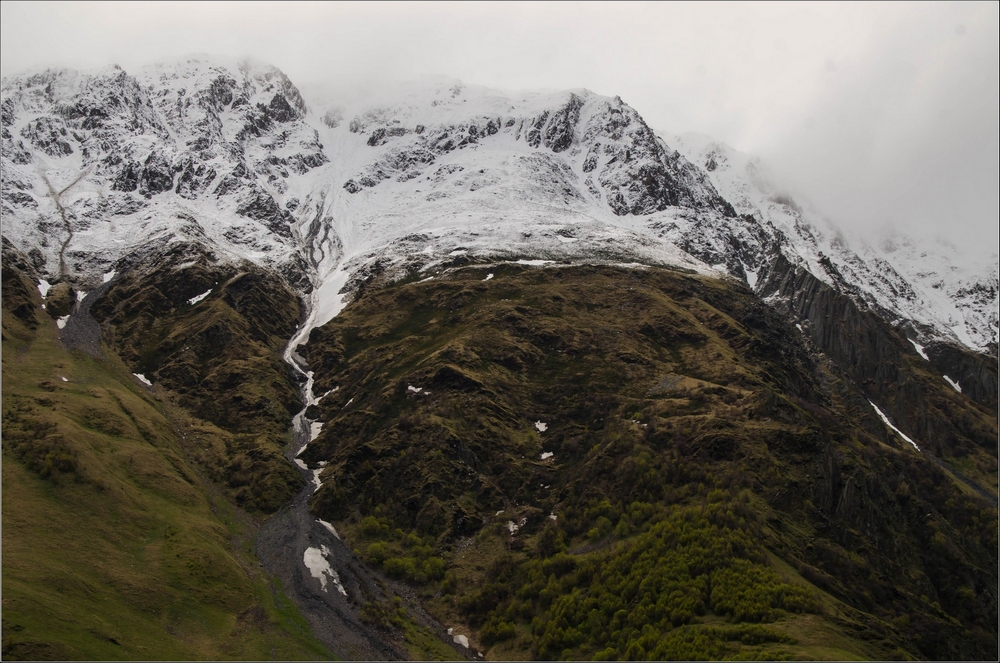
Legends of Kazbegi
Like many great mountains of the Caucasus Mountains, Mount Kazbek is surrounded by fascinating legends and myths passed down through generations.
One of the most famous legends connects the mountain with Prometheus. According to ancient Greek mythology, Prometheus gave fire to humanity, angering the gods. As punishment, he was chained to a mountain peak. In local tradition, that peak is sometimes identified with Mount Kazbek.
Another legend explains the permanent ice covering the summit. Long ago, a monk lived in the mountains near Kazbek. One day he fell from the mountain, and according to legend, God’s wrath was revealed in the appearance of an icy dome that has covered the summit ever since.
Local residents also believe that mountain spirits live in the region. These spirits are said to help travelers who lose their way in the mountains, guiding them back to safe paths. However, there is an important condition: only people with kind hearts and good intentions receive their help.
There is also a beautiful story about two legendary brothers — Mount Elbrus and Mount Kazbek. According to the legend, the two mountains were once inseparable and lived in harmony. But enemies managed to sow hatred in the heart of young Kazbek by telling him that Elbrus mocked him behind his back. Believing the deception, Kazbek distanced himself from his brother forever, and the two mountains have remained apart ever since.
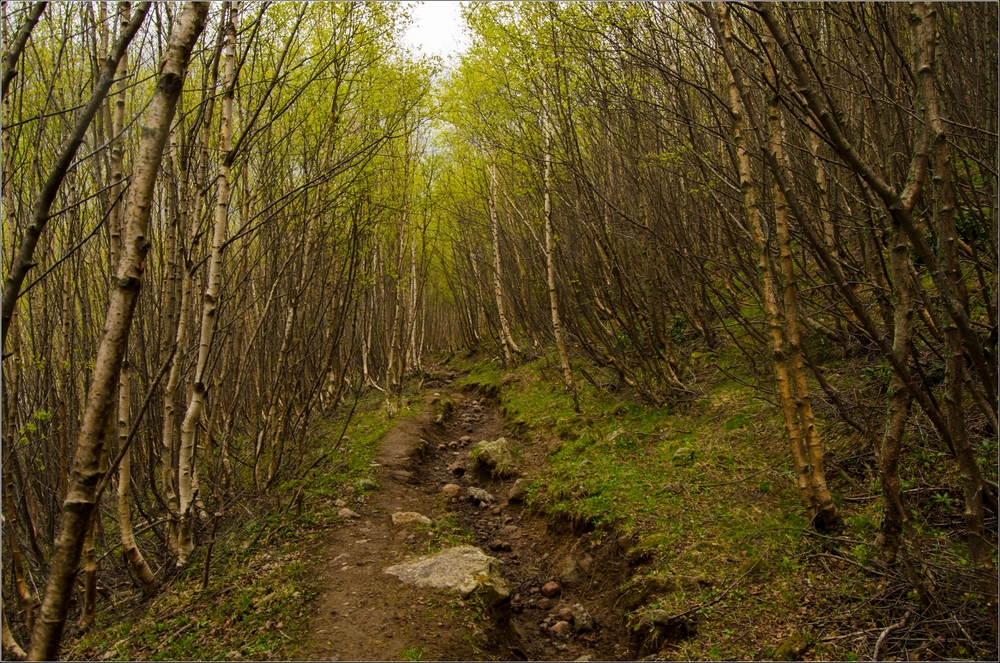
The Origin of the Name
Different peoples living around the mountain have given it their own names.
In Georgia, the mountain is known as Mkinvartsveri, which translates as “the mountain with an icy peak.”
Among the Ossetians, the mountain is called Urshoh, meaning “white mountain.”
Historically, the peak also had another name. In the 16th–17th centuries, the Ingush people referred to it as Shat-Gora, which means “snow and ice.”
The modern name Kazbek appeared only in the 19th century. At that time, a village stood at the foot of the mountain belonging to Prince Kazbek. The settlement — known as Kazbegi — was first named after the prince, and later the name was transferred to the mountain itself.
Today, Mount Kazbek remains not only a spectacular natural landmark but also a symbol of the myths, traditions, and cultural history of the Caucasus.
Attractions Around Kazbegi
Mount Kazbek is famous not only for its spectacular natural scenery but also for several remarkable historical and cultural landmarks located in its surroundings.
Gergeti Trinity Church
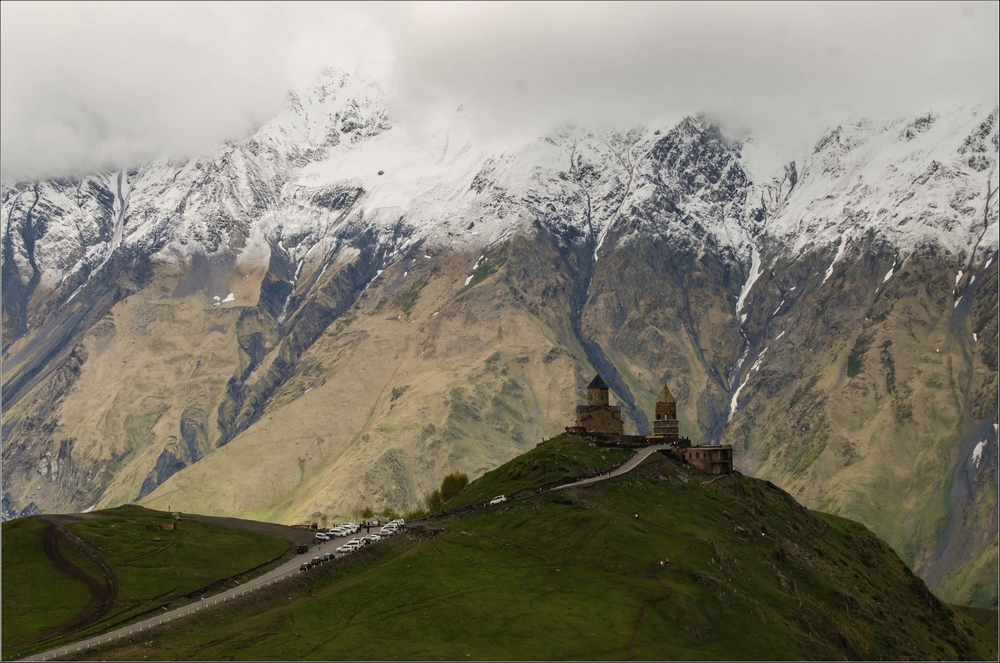
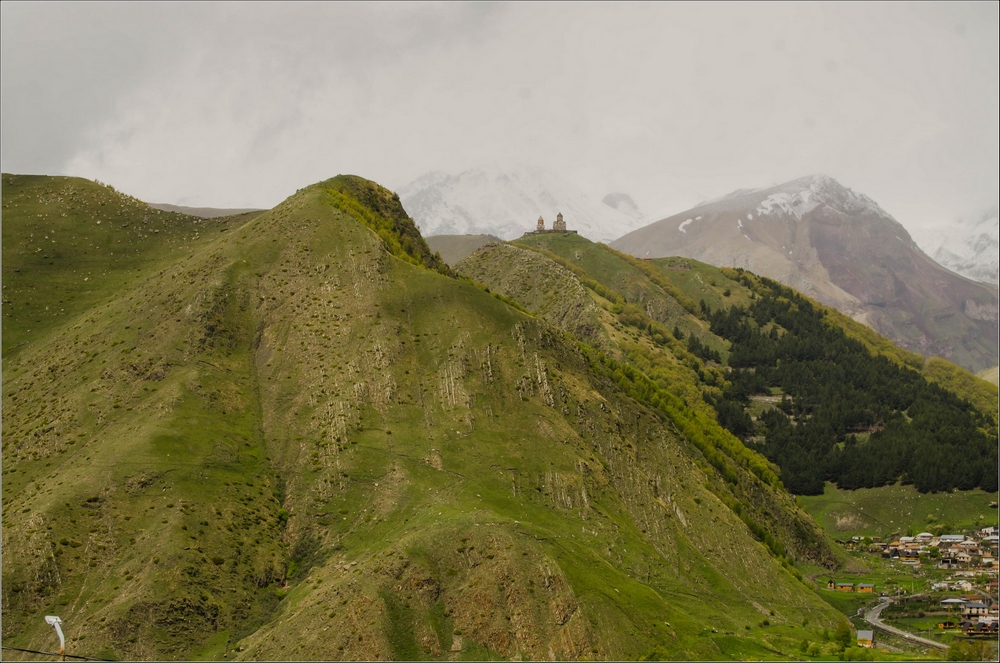
One of the most iconic landmarks in Georgia is the Gergeti Trinity Church (on the photo upper). The church stands at an altitude of 2,170 metres near the village of Gergeti, above Stepantsminda.
The church was built in the 14th century. Its interior is simple and austere: stone walls, no electricity, and fragments of ancient frescoes have survived.
However, the location is extraordinary. From the hill on which the church stands, visitors can enjoy breathtaking views of the Dariali Gorge and the surrounding mountains.
During the Soviet era, the church was closed. In 1988, a cable car connecting Stepantsminda with the church was built, but it was later dismantled at the request of local residents. Today the church belongs to the Georgian Orthodox Church.
Betlemi Cave Monastery (Bethlehem Cave)
High on the slopes of Mount Kazbek lies the mysterious Betlemi Cave, also known as Bethlehem Cave. It is located at an altitude of about 4,100 metres above sea level, with the entrance carved directly into the rock roughly 400 metres above the mountain’s base.
According to one theory, monks once reached the cave using an iron chain attached to the cliff. The chain and an iron gate leading to the cave were discovered in 1947.
Further archaeological work in 1948 uncovered several historical artifacts, including: a church banner, coins and various religious utensils
Nearby researchers also found monastic cells carved into the rock, a stone cross, and a tombstone. Scholars believe the monastic complex was built in the 6th–7th centuries.
Weather Station
Another interesting site on the slopes of Mount Kazbek is the high-altitude weather station, located at 3,675 metres above sea level. The building was constructed in 1933, although it operated only for a relatively short period.
Today, climbers often use the structure as a rest stop during their ascent to the summit of Kazbek. Slightly above the station, at an altitude of about 3,900 metres, stands a small mountain chapel, which has become another landmark for mountaineers on their way to the peak.
Georgian Military Highway
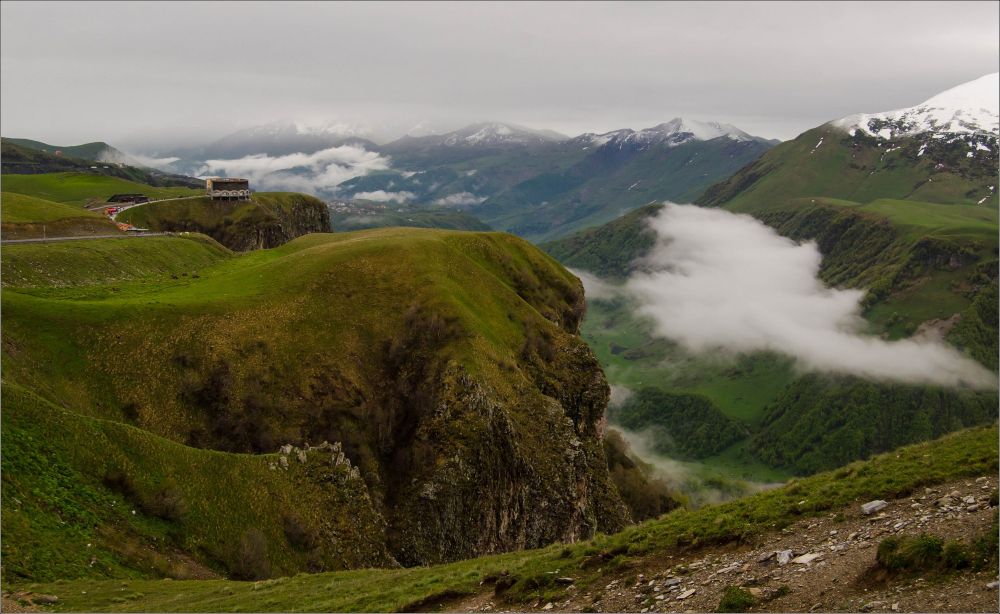
One of the most famous roads in the Caucasus, the Georgian Military Highway, runs along the main ridge of the Caucasus Mountains. The highway stretches for about 208 kilometres, connecting the cities of Vladikavkaz and Tbilisi.
The road is considered one of the most picturesque routes in the Caucasus. Along the way travelers can see numerous natural and historical landmarks, including:
- the mountain town of Stepantsminda, located at the foot of Mount Kazbek
- the famous Gergeti Trinity Church
- the Aragvi River and Terek River
- the medieval Ananuri Fortress
- the scenic Sno Valley
- mineral springs and numerous mountain viewpoints
Climbing Kazbegi
Climbing Mount Kazbek is a challenging but rewarding adventure for experienced mountaineers. There are two main routes used to reach the summit.
Southern Route (Georgia)
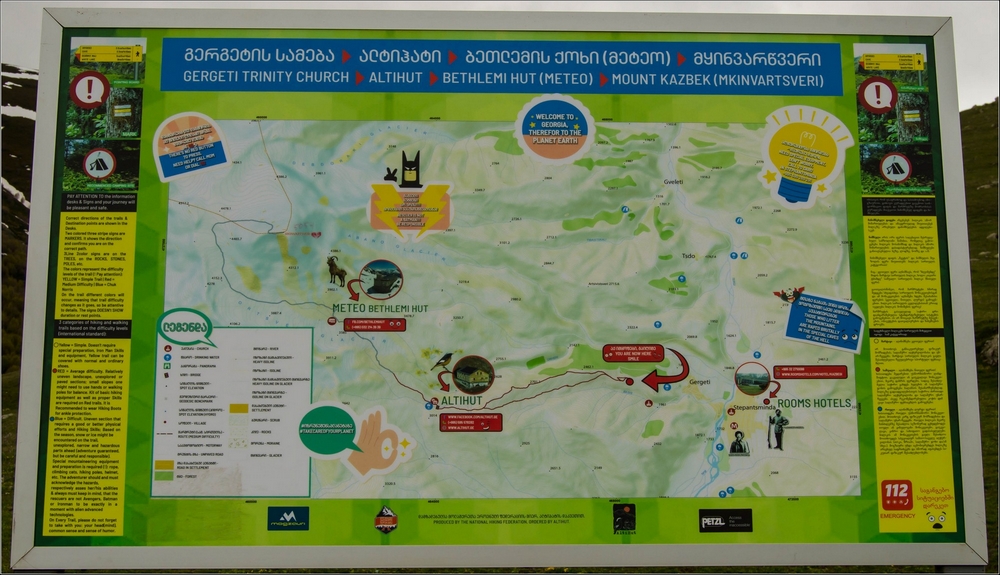
The most popular route begins in Stepantsminda in Georgia. From the village, climbers ascend via the Gergeti Glacier and pass the high-altitude weather station, which serves as an important rest point during the climb.
This route is considered the standard ascent and is used by most mountaineering expeditions.
Northern Route (Russia)
Another route approaches the mountain from the north through North Ossetia–Alania in Russia. Climbers usually travel from Vladikavkaz to the village of Karmadon, located about 40 kilometres away.
However, this route has almost no tourist infrastructure. The area once functioned as a resort, but in 2002 the Kolka Glacier collapsed, destroying roads, houses, and recreation facilities in the valley. Climbers also need to cross the international border and obtain a Russian visa, which makes this route less common.
Best Season for Climbing
Climbing Kazbek requires good physical preparation and should be done with experienced guides. The most suitable months are:
- July
- August
- September
- sometimes early October
During these months weather conditions are usually more stable and glaciers are safer to cross.
Alexander Kazbegi
The village of Stepantsminda is also the birthplace of the Georgian writer Alexander Kazbegi, who was born on 20 January 1848 into a wealthy noble family in the historic region of Khevi, near Mount Kazbek.
After inheriting a large estate from his father, Kazbegi improved the living conditions of his serfs and later even worked as a shepherd in the mountains, seeking to understand the life of local people.
Until the age of twelve he was educated by private tutors, including Georgian peasant women whose work he valued highly. Later he studied in Russia and from 1879 lived in Tbilisi, where he worked for the newspaper Droeba.
Kazbegi’s literary works focused on the life of mountain communities and often explored the conflict between individual freedom and traditional social norms. Most of his works were written between 1880 and 1886.
His writing also influenced Joseph Stalin. According to one version, Stalin’s revolutionary pseudonym Koba was taken from a heroic character in Kazbegi’s novella The Parricide, where the character is portrayed as a noble outlaw fighting for justice.
Infrastructure
The main tourist infrastructure for visiting Kazbek is located in Stepantsminda, a popular mountain settlement in the central part of the Greater Caucasus.
The village lies at an altitude of 1,744 metres on the right bank of the Terek River, along the Georgian Military Highway, about 11 kilometres south of the Russian border at Upper Lars.
Stepantsminda offers the main facilities for visitors, including:
- hotels and guesthouses
- administrative and cultural institutions
- educational and medical facilities
- small businesses that process agricultural products and bottle mineral water
Because of its location, the village serves as the main base for trekkers and climbers heading to Mount Kazbek.
Climate in Kazbegi
The region around Kazbek has a mountain climate.
- Winters are relatively mild with stable snow cover. The average temperature in January is about −5 °C
- Summers are moderately warm. The average temperature in August is about 14 °C
- Relative humidity in summer is around 72%
- Annual precipitation is approximately 800 mm
Even if you are only planning hiking or sightseeing in the Kazbek area, it is important to bring warm clothing and a raincoat. Mountain weather can change quickly, and conditions may become cold or rainy even during summer.
How to Get to Kazbegi
The most common way to reach Kazbek is through Stepantsminda.
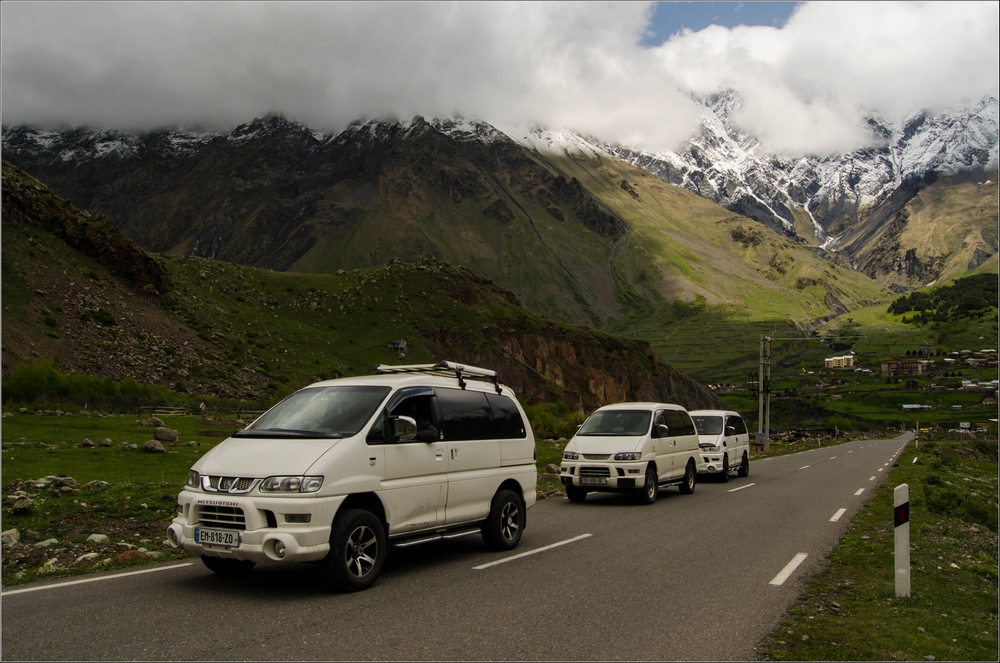
By Minibus
Minibuses depart from Didube Bus Station near the Tbilisi Metro in Tbilisi.
The exact timetable may vary, but usually there is a morning departure and an evening return trip. It is recommended to confirm the schedule in advance by contacting the station.
By Car
Traveling by car is another popular option. The distance from Tbilisi to Stepantsminda is about 156 kilometres along the scenic Georgian Military Highway.
However, drivers should be cautious, as the road passes through mountainous terrain with sharp turns and steep sections.
The best way to rent a car in Georgia is Localrent, this search engine works with local companies directly and provides exact cars, not the similar. Or you can use Discover Cars or the oher agregator which works in Georgia.
By Taxi
Visitors can also use local taxi services, which operate regularly between Tbilisi and Stepantsminda. This is often the most convenient option for travelers who prefer a direct and flexible journey.
Guided tours
The most comfortable way to explore Kazbegi from Tbilisi is to take guided tour. In this case you can relax and see around with the glass of Georgian wine. You can find some packages on Tripadvisor.com or with Get Your Guide (use the forn below).
Location and Coordinates
For travelers planning a visit, the coordinates of Mount Kazbek are:
- Latitude: 42.696718
- Longitude: 44.514913